
Histamine, MCAS and arrhythmias
A brief disclaimer: this article does not contain medical advice. It is background reading to help you ask better questions — always discuss your symptoms, and any change you are considering, with your own doctor.
A common pattern
A person eats aged cheese, drinks a glass of red wine, and by midnight the heart is racing. In other cases there is no food involved at all. A hot shower or a stressful phone call is enough to bring on palpitations.
What links these situations is often histamine, released by mast cells.
What histamine is
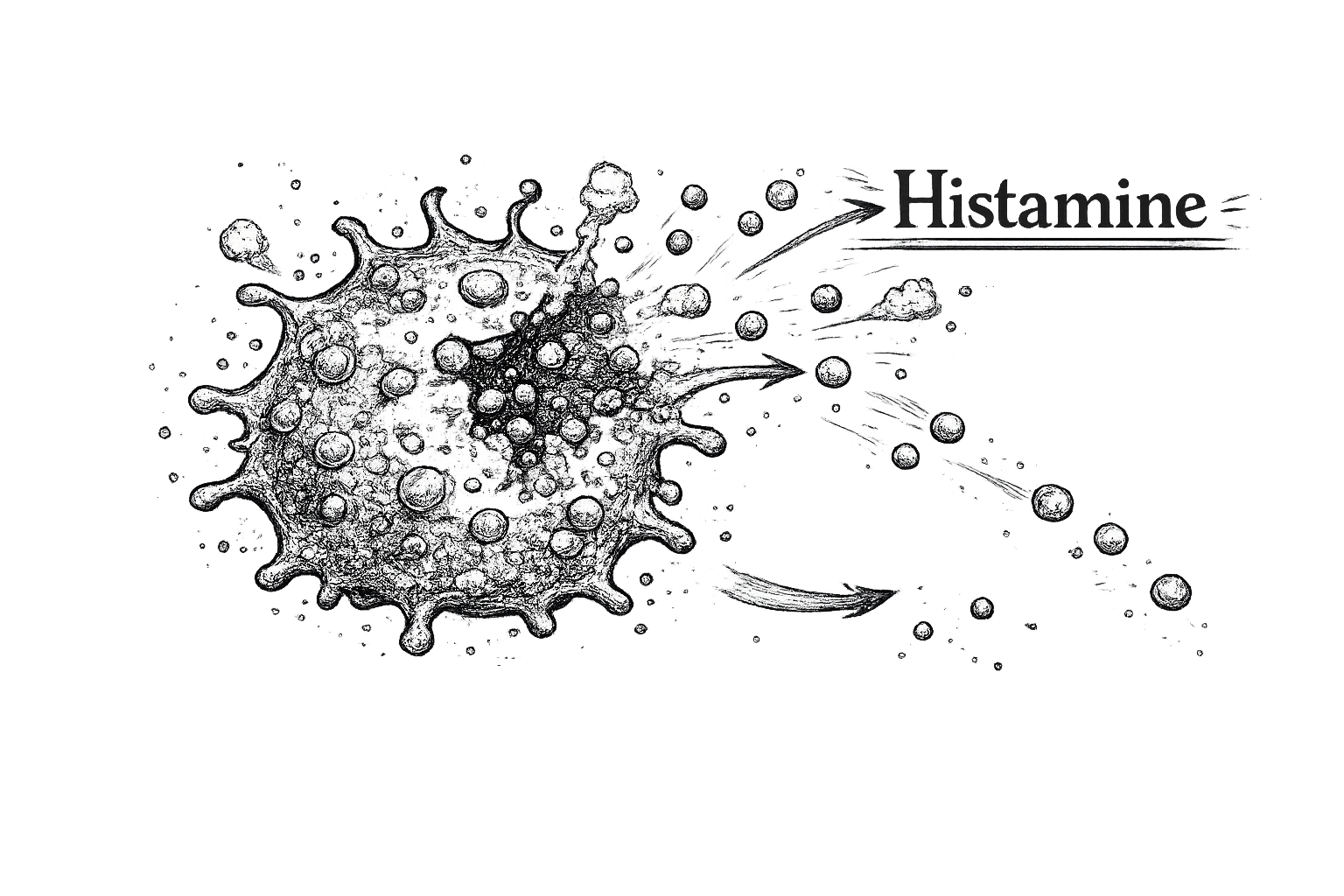
Histamine is a small molecule the body produces on purpose. It is stored inside mast cells, which are immune cells found in the skin, gut, lungs, sinuses, and the heart. It is released when those cells are triggered.
Most people know histamine as the allergy chemical behind sneezing, itching, hives, and a runny nose. It has other functions as well.
In small, short bursts it is useful. In sustained surges, or in a body that cannot break it down fast enough, it causes problems. Mast cells sit close to the electrical tissue of the heart, so cardiac symptoms often appear early.
Histamine intolerance and MCAS are not the same
Histamine intolerance (HIT) and Mast Cell Activation Syndrome (MCAS) are related but different conditions.
Histamine intolerance is a breakdown problem. The body cannot clear histamine fast enough, often because of low diamine oxidase (DAO) activity in the gut. Histamine from food, drink, and internal production builds up.
MCAS is a release problem. The mast cells themselves are overactive. They degranulate for the wrong reasons and at the wrong times, releasing not only histamine but also tryptase, prostaglandin D2, leukotrienes, heparin, and TNF-alpha.
The cardiac symptoms can look identical, but the treatment targets differ. One is an enzyme problem. The other is a problem of cell regulation.
The cardiac phenotype
Several peer-reviewed papers describe a cardiovascular-predominant phenotype of MCAS, in which palpitations, tachycardia, presyncope, and arrhythmias are the main symptoms.
Kolck, Haenisch, and Molderings (2016) documented a subset of patients whose main complaint was cardiovascular. In these patients the heart itself is not damaged. It is simply where the symptoms appear.
This makes mast cell disorders worth considering when a structurally normal heart keeps producing symptoms.
Histamine receptors in the heart
Histamine acts by binding to receptors. The heart has several types of histamine receptor, and they do different things. Some increase heart rate. Some change how electrical signals travel. Others affect blood vessel tone or interact with the immune and nervous systems.
One chemical can therefore have several effects at once. A single histamine release can produce palpitations, PACs, inappropriate sinus tachycardia, short runs of atrial tachycardia, and, in susceptible people, atrial fibrillation triggers.
Kounis syndrome
Kounis syndrome is the acute and dangerous end of the spectrum. An allergic or anaphylactoid event triggers coronary vasospasm, plaque rupture, or stent thrombosis. Three types exist. It is rare and is not the explanation for most benign palpitations, but it shows that histamine and the heart have a documented relationship.
The POTS, MCAS and hEDS overlap
Three conditions often occur together: Postural Orthostatic Tachycardia Syndrome, Mast Cell Activation Syndrome, and hypermobile Ehlers-Danlos Syndrome.
The overlap is common enough that some researchers argue they share a single underlying cause. Others disagree, and the debate is ongoing.
This combination is worth investigating in a patient who is hypermobile, bruises easily, has palpitations after eating leftovers, and feels faint in hot showers.
Why the arrhythmias seem random
Triggers add up. A single trigger may cause no symptoms, while several small ones on the same day do.
A glass of wine alone might have no effect. The same glass of wine combined with leftover pasta, a stressful afternoon, and a hot bath can be enough to cause symptoms.
For example, a person has aged cheese at lunch, coffee in the afternoon, a small glass of red wine with dinner, and a hot shower at 10 PM. By midnight the heart is running at 120 bpm at rest, and the food diary records a normal day.
Triggers for histamine intolerance and MCAS
- High-histamine foods — aged cheese, cured meats, fermented products, leftovers, sauerkraut, wine, beer, champagne, vinegar, kombucha, soy sauce, tomatoes, spinach, eggplant, old food
- Histamine liberators — strawberries, pineapple, papaya, citrus, chocolate, shellfish
- Temperature shifts — hot showers, cold plunges, sauna, sudden weather changes
- Physical triggers — exercise in some people, vibration, friction on the skin
- Hormonal shifts — menstrual cycle, perimenopause, pregnancy
- Medications — NSAIDs, opioids, muscle relaxants, contrast dye, certain antibiotics
- Stress
- Mold, toxins, chemicals, strong scents
- Infections
Palpitations that appear without an obvious cause often come from several of these triggers combining.
Symptoms beyond the heart
MCAS and histamine intolerance rarely cause cardiac symptoms alone. The usual cluster includes:
- Flushing, especially of the face, neck, and chest
- Itchy skin, hives, or dermographism
- Nasal congestion, sneezing, post-nasal drip
- Abdominal pain, bloating, reflux, loose stools
- Headaches or migraines
- Brain fog, irritability, anxiety spikes
- Sleep disturbance, especially waking between 2 and 4 AM
- Fatigue that persists after a full night of sleep
When several of these occur together, mast cells are a likely common cause. The cardiac symptoms are only one part of the picture.
Why doctors miss it
MCAS is hard to diagnose. Standard MCAS biomarkers are often normal between flares, and many labs and clinics do not offer full testing for mast cell mediators.
Histamine intolerance is also hard to diagnose. DAO blood tests are unreliable, and there is no single marker that confirms the diagnosis.
What testing looks like
If the pattern fits, the next step is a consultation with a clinician familiar with mast cell disorders. Several blood, urine, and genetic tests can be useful, but each has timing rules and reliability limits. Choosing the right combination and interpreting the results is specialist work.
One practical first step needs no lab testing: a structured low-histamine elimination trial combined with a careful trial of antihistamines, ideally under medical guidance. The response to this trial is often more informative than a single lab value.
What helps
Treatment usually combines several measures:
- Dietary load reduction — a temporary low-histamine diet lowers the baseline.
- DAO supplementation — taken before meals. More useful for HIT than for MCAS.
- H1 blockers — cetirizine, loratadine, fexofenadine.
- H2 blockers — famotidine is the most commonly used.
- Mast cell stabilisers — cromolyn sodium, ketotifen, quercetin, luteolin. These prevent degranulation rather than block receptors.
- Vitamin C — supports DAO function and has a mild stabilising effect.
- Trigger identification — food diaries, environmental logs, sleep logs.
This approach should be carried out under specialist supervision rather than on your own.
Related conditions and recovery
Histamine problems often occur alongside salicylate intolerance, oxalate issues, SIBO, mold toxicity, and autonomic dysfunction. The more of these are present, the more likely mast cells are involved.
Histamine-driven palpitations often improve within days once the histamine load is reduced and basic antihistamines are started. Some people notice a calmer heart within a week. Full MCAS stabilisation takes months, especially when infections, mould exposure, or connective tissue problems are also present.
References:
- Afrin LB, Ackerley MB, Bluestein LS, et al. “Diagnosis of mast cell activation syndrome: a global ‘consensus-2’.” Diagnosis, 2021;8(2):137-152.
- Valent P, Akin C, Bonadonna P, et al. “Proposed Diagnostic Algorithm for Patients with Suspected Mast Cell Activation Syndrome.” Journal of Allergy and Clinical Immunology: In Practice, 2019;7(4):1125-1133.
- Kolck UW, Haenisch B, Molderings GJ. “Cardiovascular symptoms in patients with systemic mast cell activation disease.” Translational Research, 2016;174:23-32.
- Kounis NG. “Kounis syndrome: an update on epidemiology, pathogenesis, diagnosis and therapeutic management.” Clinical Chemistry and Laboratory Medicine, 2016;54(10):1545-1559.
- Maintz L, Novak N. “Histamine and histamine intolerance.” American Journal of Clinical Nutrition, 2007;85(5):1185-1196.
- Molderings GJ, Brettner S, Homann J, Afrin LB. “Mast cell activation disease: a concise practical guide for diagnostic workup and therapeutic options.” Journal of Hematology & Oncology, 2011;4:10.
- Weiler JM, Bloomfield JR, Woodworth GG, et al. “Effects of histamine H1 and H2 receptor antagonists on cardiac rhythm.” Annals of Allergy, Asthma & Immunology, 2000;85(4):279-286.
- Shibamoto T, Liu W, Cui S, et al. “PGD2-induced cardiodepression and coronary vasoconstriction are mediated through TP receptors in isolated perfused guinea pig heart.” Prostaglandins & Other Lipid Mediators, 2007;83(1-2):132-141.
- Seneviratne SL, Maitland A, Afrin LB. “Mast cell disorders in Ehlers–Danlos syndrome.” American Journal of Medical Genetics Part C, 2017;175(1):226-236.
- Shibao C, Arzubiaga C, Roberts LJ, et al. “Hyperadrenergic postural tachycardia syndrome in mast cell activation disorders.” Hypertension, 2005;45(3):385-390.
- Kovanen PT, Bot I. “Mast cells in atherosclerotic cardiovascular disease — Activators and actions.” European Journal of Pharmacology, 2017;816:37-46.
- Patella V, Marinò I, Lampärter B, et al. “Human heart mast cells. Isolation, purification, ultrastructure, and immunologic characterization.” Journal of Immunology, 1995;154(6):2855-2865.
- Marone G, Genovese A, Varricchi G, Granata F. “Human heart as a shock organ in anaphylaxis.” Allergo Journal International, 2014;23(2):60-66.
- Theoharides TC, Tsilioni I, Ren H. “Recent advances in our understanding of mast cell activation — or should it be mast cell mediator disorders?” Expert Review of Clinical Immunology, 2019;15(6):639-656.
arrhythmiasheartpalpitationshistaminemcasextrasystolespac/pvc