
Water damage, mold & CIRS
A brief disclaimer: this article does not contain medical advice. It is background reading to help you ask better questions — always discuss your symptoms, and any change you are considering, with your own doctor.
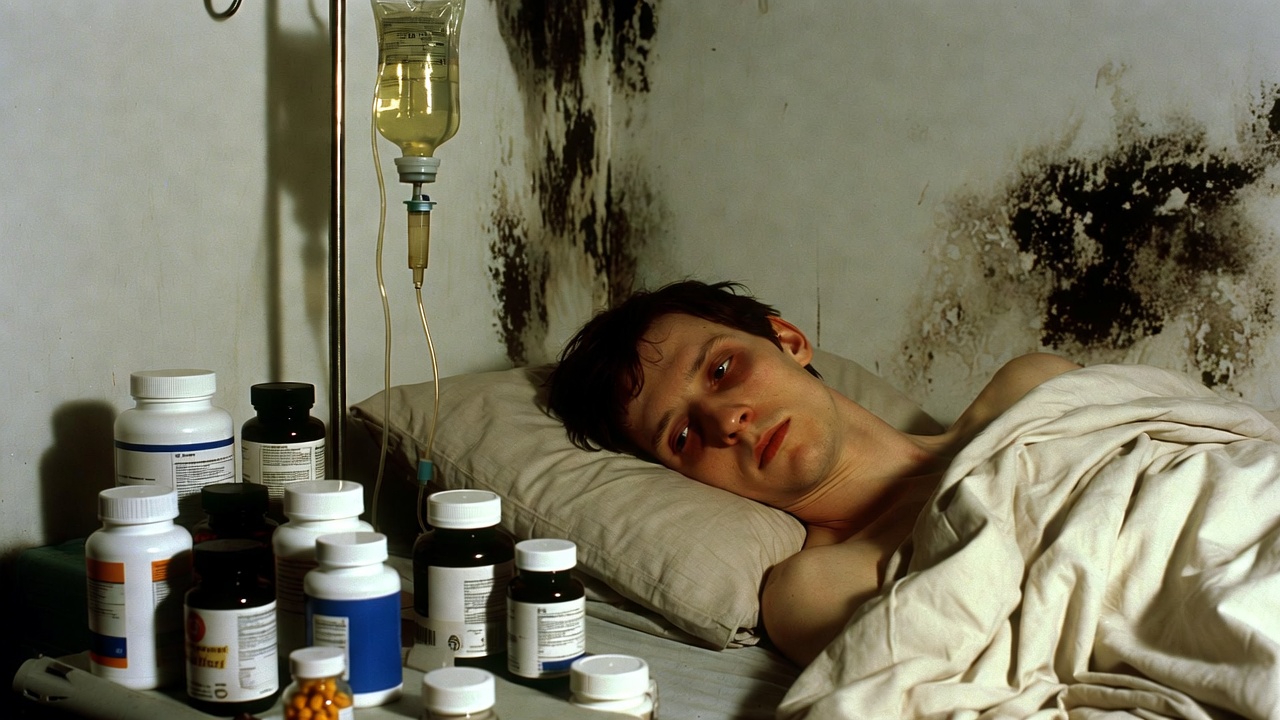
Mold and the heart
A person moves into an older rental with a humidity problem, or starts working in a basement office that smells musty. A few months later the heart starts behaving abnormally: PVCs at rest, a run of fluttering at night, a pulse of 110 while sitting on the couch.
The cardiologist finds nothing. The ENT finds nothing. The cause may be the dark spot in the ceiling corner.
Mold and mycotoxins
“Toxic mold” is a general term for indoor fungal species — including the dark-coloured one many people call “black mold”, along with several related species — that grow on damp building materials and release harmful chemicals as they live and die. Not every mold is dangerous, but where water sits for a long time, the more harmful species tend to take over.
Mold does not need a flood to establish itself. A slow roof leak, a condensing pipe behind drywall, condensation in a poorly ventilated bathroom, or moisture rising through a basement slab is enough for spores to grow. Mold can then live for years behind a wall that looks clean from the outside, releasing spores and fragments into the indoor air whenever the HVAC runs.
Common hiding places:
- Inside walls, behind wallpaper, under vinyl flooring, above ceiling tiles, and in wall cavities where insulation has been wet.
- In furniture, especially upholstered pieces that were kept in a damp basement or survived a leak. The fabric dries, but the padding and the wood frame can hold colonies for years.
- In clothes, bedding, and books that absorbed humidity in a previous home and were never decontaminated.
- In HVAC systems, which circulate spores through every room. Even after the visible damage is repaired, particles can stay on soft surfaces and move with belongings from one home to the next.
Mycotoxins are the toxic chemicals produced by these molds. They are small, oily, and very stable; heat, bleach, and normal cleaning have little effect on them. There are many types, each with its own profile, but they tend to accumulate in fatty tissue and to interfere with energy production and with the nervous, hormonal, and immune systems. Unlike the spores, mycotoxins are not alive. Removing every spore from a room leaves the toxins behind, bound to dust, fibers, and porous materials, where they can still be inhaled or touched.
This is why a mold problem is rarely solved by opening a window or wiping down a wall. The organism and the chemicals it leaves behind are two separate problems, and the heart can react to either.
CIRS
CIRS stands for Chronic Inflammatory Response Syndrome, a term introduced by Dr. Ritchie Shoemaker for a multi-system, biotoxin-driven illness that does not resolve on its own and continues after the exposure ends.
The trigger is usually mold from a water-damaged building, though other biotoxins can cause it as well. Genetically susceptible people cannot clear it efficiently, so the immune system keeps reacting and the inflammation does not switch off.
Many people carry HLA-DR haplotypes that make biotoxin clearance inefficient. In these people the immune system cannot tag mycotoxins for removal properly. This is why several people can live in the same moldy building and only some of them become ill.
The toxins keep circulating, the inflammatory signals continue, and the symptoms accumulate for months or years after the exposure ends.
How mycotoxins affect the heart
Mycotoxins pass through cell membranes, accumulate in fat, and build up in tissues. They reach the heart through several mechanisms at the same time.
Reduced energy production. Mycotoxins disrupt the way heart cells produce energy, and cells with low energy are more likely to fire abnormally.
Disrupted electrical signaling. Heart rhythm depends on precisely timed electrical signals between cells. Some mycotoxins interfere with that timing, which makes extra beats and abnormal rhythms more likely.
Autonomic nervous system disruption. Mold illness often affects the autonomic nervous system, which controls heart rate, blood pressure, and breathing. The heart then receives conflicting signals at unpredictable times.
Vascular inflammation. As inflammation rises, the lining of small blood vessels stops working normally. Blood flow through the small vessels of the heart decreases, and a poorly supplied conduction system is more likely to produce abnormal rhythms.
Persistent inflammation
Normal inflammation rises, peaks, and resolves. In CIRS it stays elevated for months.
The heart is exposed to that inflammation the whole time. The pericardium, the conduction system, the atrial myocardium, and the coronary endothelium are all under persistent low-grade inflammation. This may be why the palpitations differ from anxiety and from structural heart disease: the pattern is irregular, it changes over time, and it does not respond to the usual cardiac treatments.
Testing the building
In CIRS the building is investigated as well as the patient.
Water-damaged buildings contain several sources of contamination at once: different mold species, bacteria, and dust mites, each adding its own biological pollution. No single test captures all of it.
Specialised dust testing of the home gives an objective measure of how heavy the contamination is. Several labs offer this analysis, and a knowledgeable practitioner or a building professional can recommend which one to use.
Testing the building before spending months on medical workups is usually the better order. If the exposure continues, treatment will not hold.
Symptoms outside the heart
CIRS is rarely limited to cardiac symptoms. The usual cluster includes:
- Fatigue that does not improve with sleep
- Brain fog, word-finding problems, executive dysfunction
- Static shocks, unusual light sensitivity, or “ice pick” headaches
- Sinus congestion, post-nasal drip, chronic cough
- Muscle cramps, joint pain that moves from one place to another
- Unusual thirst with frequent urination
- Mood swings, anxiety, air hunger
- Temperature dysregulation, night sweats
- New food sensitivities, histamine-style reactions
- Numbness, tingling, tremors
A simple early screening test
The Visual Contrast Sensitivity test is a quick, low-cost first check. Inflammation from biotoxins appears to reduce how well the visual system distinguishes shades of grey. The test is not a diagnosis on its own, but a clear pass makes a biotoxin-driven illness less likely, and a clear fail is a reason to investigate further.
It is worth doing before ordering expensive labs. A free online version is available at vcstest.com, though the in-office version is more reliable. It asks for a donation at the end, but the donation is optional on the first test.
Labs worth running
The mold-illness lab panel is uncommon, and most standard offices will not order it without a specific request. A practitioner familiar with the illness will usually check:
- Several markers of chronic inflammation that tend to stay elevated in mold-driven illness
- A few regulatory hormones that often run low and explain symptoms such as brain fog, fatigue, and unusual thirst
- A genetic test that shows whether the immune system has trouble clearing biotoxins
- A deep nasal swab for persistent bacteria that can keep the inflammation going
A full panel is expensive, but running a few of these early can direct the workup and avoid months of guessing.
The Shoemaker protocol
There is a defined treatment pathway for mold illness, the Shoemaker protocol, a staged, sequential process developed by Dr. Ritchie Shoemaker over decades of clinical work, and it works for many people. The main steps are: leave the contaminated environment, use binders to absorb the toxins still circulating in the body, clear persistent nasal bacteria, reduce the inflammation, and gradually bring the regulatory hormones back to normal. Each step has its own labs, its own target, and its own place in the order. Skipping steps usually stalls the whole sequence.
Not everyone tolerates the full protocol, and not everyone needs every stage. Some patients improve with more natural or integrative approaches: activated charcoal, bentonite clay, chlorella, glutathione support, sauna, nasal antimicrobials from essential oils, binders such as modified citrus pectin, and attention to drainage pathways before starting detoxification. These approaches are gentler, slower, and less studied, but for some people they are what finally produces improvement.
This is not a decision to make alone. CIRS treatment — classical Shoemaker, a natural variant, or a combination — needs a practitioner who knows the illness. Most general physicians do not. A Shoemaker-certified doctor, or a functional medicine practitioner with real CIRS experience, is worth the effort to find.
For a broader view, Dr. Neil Nathan’s book Toxic is a good place to read further. Nathan works with the sickest and most sensitive patients, and his book covers both the Shoemaker framework and the adjustments needed for people who cannot tolerate aggressive detoxification.
The documentary Moldy is free online at moldymovie.com. It collects patient stories, practitioner interviews, and a practical overview of how water-damaged buildings make people sick. It is useful for explaining the illness to a partner, a landlord, or a skeptical family member.
Recovery time
CIRS recovery is slow. Some people get significant relief from palpitations within weeks of starting binders. Others need the full protocol before the rhythm settles.
For someone with a water-damaged home, multi-system symptoms, a positive VCS test, and a matching lab panel, this is a root cause that will not resolve on its own.
More information about mold and CIRS can be found at survivingmold.com
References:
- Shoemaker RC, House DE. “Sick building syndrome (SBS) and exposure to water-damaged buildings: time series study, clinical trial and mechanisms.” Neurotoxicology and Teratology, 2006;28(5):573-588.
- Shoemaker RC, Johnson K, Jim L, et al. “Diagnostic Process for Chronic Inflammatory Response Syndrome (CIRS): A Consensus Statement Report of the Consensus Committee of Surviving Mold.” Internal Medicine Review, 2018;4(5).
- Shoemaker RC, Mark L, McMahon SW, et al. “Policyholders of America research committee report: Research committee report on diagnosis and treatment of chronic inflammatory response syndrome caused by exposure to the interior environment of water-damaged buildings.” 2010.
- Brewer JH, Thrasher JD, Straus DC, et al. “Detection of mycotoxins in patients with chronic fatigue syndrome.” Toxins, 2013;5(4):605-617.
- Hope J. “A review of the mechanism of injury and treatment approaches for illness resulting from exposure to water-damaged buildings, mold, and mycotoxins.” The Scientific World Journal, 2013;2013:767482.
- Thrasher JD, Crawley S. “The biocontaminants and complexity of damp indoor spaces: more than what meets the eyes.” Toxicology and Industrial Health, 2009;25(9-10):583-615.
- Ryan JC, Wu Q, Shoemaker RC. “Transcriptomic signatures in whole blood of patients who acquire a chronic inflammatory response syndrome (CIRS) following an exposure to the marine toxin ciguatoxin.” BMC Medical Genomics, 2015;8:15.
- Pei R, Wang G, Wang H, et al. “Toxic effects of ochratoxin A on the cardiovascular system.” Frontiers in Pharmacology, 2021;12:717045.
- Doi K, Uetsuka K. “Mechanisms of mycotoxin-induced dermal toxicity and tumorigenesis through oxidative stress-related pathways.” Journal of Toxicologic Pathology, 2014;27(1):1-10.
- Empting LD. “Neurologic and neuropsychiatric syndrome features of mold and mycotoxin exposure.” Toxicology and Industrial Health, 2009;25(9-10):577-581.
- Campbell AW, Thrasher JD, Gray MR, Vojdani A. “Mold and mycotoxins: effects on the neurological and immune systems in humans.” Advances in Applied Microbiology, 2004;55:375-406.
- Valtonen V. “Clinical diagnosis of the dampness and mold hypersensitivity syndrome: review of the literature and suggested diagnostic criteria.” Frontiers in Immunology, 2017;8:951.
- Berndtson K, McMahon S, Ackerley M, et al. “Medically sound investigation and remediation of water-damaged buildings in cases of CIRS-WDB.” Surviving Mold, 2016.
- Harding CF, Pytte CL, Page KG, et al. “Mold inhalation causes innate immune activation, neural, cognitive and emotional dysfunction.” Brain, Behavior, and Immunity, 2020;87:218-228.
moldcirsarrhythmiasheartpalpitations