
Oxidative stress, mitochondrial dysfunction and arrhythmias
A brief disclaimer: this article does not contain medical advice. It is background reading to help you ask better questions — always discuss your symptoms, and any change you are considering, with your own doctor.
A common pattern
A person finishes a heavy fried dinner, lies down, and within an hour the chest starts fluttering. Or wakes up at 3 AM with a pounding heart after a day of poor sleep, skipped meals, and too much coffee.
Nothing unusual in the diet. No allergens. No wine, no cheese. The heart still reacts. One likely cause is oxidative stress.
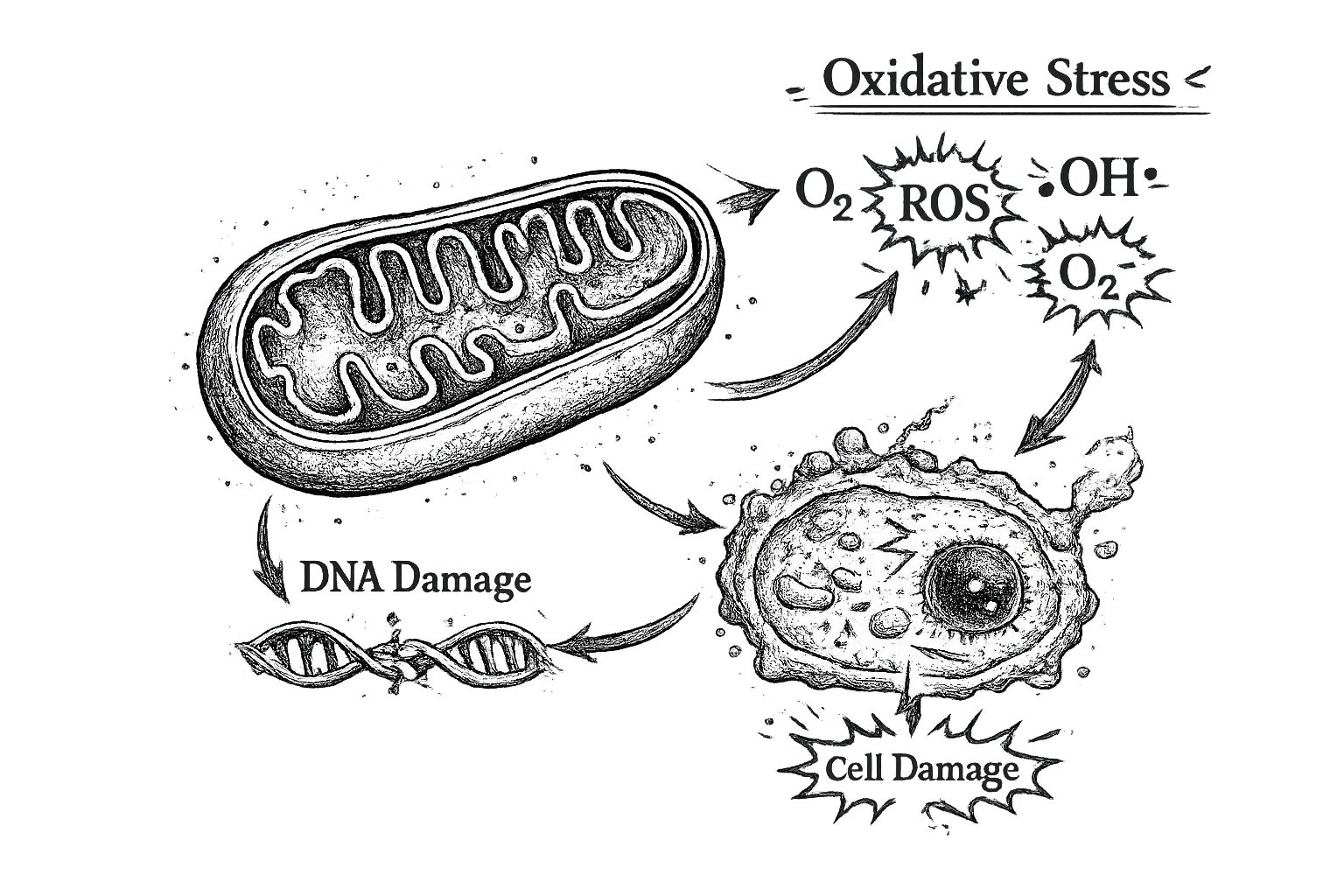
When reactive oxygen species (ROS) accumulate faster than antioxidants can neutralise them, the ion channels stop working normally. Sodium channels stay open longer than they should, calcium handling becomes imprecise, and potassium currents weaken. The action potential becomes unstable. This is the mechanism behind a large share of triggered arrhythmias in hearts that are structurally normal.
The acute phase
Chronic, low-grade oxidative stress produces vague symptoms, because the body adapts to it.
An acute oxidative spike is different. Something raises ROS sharply — a meal, an infection, a stressful event, a sleepless night — and the antioxidant systems cannot keep up. Glutathione is depleted and superoxide dismutase saturates.
That window, often one to six hours long, is when arrhythmias appear. The heart is not diseased; it is chemically and electrically unstable for a short period. This can mean PACs, PVCs, short atrial tachycardias, or, in susceptible people, paroxysmal atrial fibrillation with no obvious trigger.
Meals that worsen things
- Deep-fried food — oxidised seed oils carry pre-formed lipid peroxides into the bloodstream.
- Industrial seed oils — sunflower, soybean, corn, canola, grapeseed; high in linoleic acid and prone to peroxidation even at moderate heat.
- Repeatedly heated oils — restaurant fryers, leftovers reheated in oil.
- High-carb meals — large amounts of refined starch or sugar cause glucose spikes after eating, which generate mitochondrial superoxide.
- High-glycaemic carbs eaten alone — white bread, pastries, sweetened drinks.
- Large portions of charred or grilled meat — AGEs and heterocyclic amines increase the oxidative load.
- Alcohol, especially late at night — acetaldehyde depletes glutathione quickly.
- Processed meats with nitrites combined with high iron — a pro-oxidant combination.
- Excess omega-6 without omega-3 balance — makes cell membranes easier to oxidise.
- Skipped meals followed by a large meal — the refeeding spike produces a large amount of ROS.
Meals that reduce oxidative load
- Polyphenol-rich foods — extra virgin olive oil, blueberries, pomegranate, dark chocolate (low sugar), green tea, rosemary, oregano, apples.
- Sulphur-containing vegetables — garlic, onions, leeks, cruciferous vegetables. They support glutathione production.
- Oily fish two to three times a week.
- Nuts and seeds in moderation — vitamin E, selenium, magnesium.
- Coloured vegetables — carotenoids, flavonoids, anthocyanins.
- Adequate protein — glycine, cysteine and glutamine are used directly to make glutathione.
Read first the chapters about salicylates, histamine and MCAS. Some polyphenol-rich foods can be problematic in these cases.
Meal timing
A light salad eaten at 11 PM is still a problem. Eating late shortens the nightly repair window, and mitochondria cannot carry out repair while digestion is in progress.
A useful pattern for people with nocturnal arrhythmias: finish eating at least three hours before bed, keep dinner moderate, and avoid alcohol with dinner.
Other oxidative triggers
- Poor sleep — especially fewer than six hours, or fragmented sleep
- Prolonged stress — cortisol and catecholamines both generate ROS
- Infections — viral, bacterial, and low-grade chronic infections
- Environmental toxins — air pollution, mould, pesticides, heavy metals
- Smoking and secondhand smoke — a large pro-oxidant load
- Overtraining — training load that moves from beneficial to damaging
- Iron overload — free iron generates ROS through the Fenton reaction
- Medications — some antibiotics, chemotherapy agents, anaesthetics
- Blood sugar instability — both hyperglycaemia and reactive hypoglycaemia
When several of these occur together, the acute oxidative phase lasts hours instead of minutes.
Mitochondria and the Cell Danger Response
Oxidative stress and mitochondrial dysfunction are closely linked. Healthy mitochondria produce small, controlled amounts of ROS as part of normal energy metabolism. Damaged or overloaded mitochondria leak electrons, generate excess superoxide, and lose the ability to regulate calcium, which is the combination that destabilises atrial cells.
The process reinforces itself: ROS damages mitochondrial membranes and mtDNA, damaged mitochondria produce more ROS, and the cell either repairs them (mitophagy) or shifts into a defensive state. Atrial myocytes have unusually dense mitochondria, so the heart is affected early.
When the stress is sustained, cells shift into what researchers call the Cell Danger Response (CDR), a protective metabolic state first described by Robert Naviaux. In CDR, cells partly shut down normal energy metabolism, stiffen their membranes, release ATP and other danger signals, and prioritise defence over normal function. This is useful short-term and harmful long-term. Many features of chronic fatigue, post-viral syndromes and unexplained arrhythmias fit this pattern better than any single diagnosis.
Naviaux’s work on the Cell Danger Response is worth reading if chronic palpitations occur together with fatigue, brain fog, and slow recovery from ordinary stressors.
Oxidative stress compared with MCAS
MCAS and oxidative stress overlap in many ways. The main differences are below.
Trigger profile. MCAS follows specific triggers: aged cheese, wine, leftovers, heat, strong smells. The list is narrow and reproducible. Oxidative episodes follow the overall oxidative load: fried food, high-sugar meals, poor sleep, overtraining. The pattern is broader.
Accompanying symptoms. MCAS causes flushing, itching, nasal congestion, bloating and dermographism, so the cardiac symptoms rarely occur alone. Oxidative episodes involve fewer skin symptoms. Fatigue, brain fog and muscle soreness are common, but not histamine-type flushing.
Timing. MCAS symptoms usually peak right after a meal or a trigger. Oxidative palpitations are spread more widely: after a meal with some delay, mid-afternoon, or early morning when glutathione is low.
Response to antihistamines. MCAS often improves with H1 and H2 blockers within days. Oxidative episodes respond little. They respond instead to better sleep, antioxidant-rich meals, removal of pro-oxidant foods, and sometimes CoQ10, magnesium or NAC.
Response to stress. Both worsen with stress, but MCAS reactions often include flushing and itching, while oxidative reactions are more internal: chest tightness, PVCs, headaches, fatigue.
The two conditions often overlap. Oxidative stress activates mast cells, and mast cell activation generates ROS, so each one drives the other. The dominant driver can usually be identified with a careful symptom log.
What helps
- Meal composition — polyphenols, sulphur vegetables, quality protein at every meal.
- Meal timing — finish dinner three hours before bed.
- Sleep — seven to eight hours, dark, cool, uninterrupted.
- Magnesium — glycinate or malate, in the evening.
- CoQ10, preferably ubiquinol — ubiquinol is the reduced, active antioxidant form; ubiquinone is the oxidised form the body must convert before use. Both work, but conversion efficiency drops with age, thyroid problems and statin use, so ubiquinol is the better choice when those factors are present.
- N-acetylcysteine (NAC) — a glutathione precursor, short-term during high oxidative load.
- Vitamin C and E — moderate doses, from food when possible.
- Selenium and zinc — cofactors for antioxidant enzymes.
- Grounding — direct skin contact with the ground.
- Reduce EMF — turn off wifi at night, do not sleep with the phone near the bed.
- Reducing iron overload — monitor iron markers.
- Stress reduction — relaxation, walks, not using alcohol to relax.
Excessive antioxidant supplementation can be counterproductive. The body needs a certain level of ROS as a signal to adapt, so moderation matters more than high doses.
Acute oxidative arrhythmias often settle within a week or two of structured changes. A person who stops eating fried food at 9 PM, sleeps an extra hour, and adds blueberries and olive oil to the diet often reports fewer nighttime palpitations within days.
Grounding
Walking barefoot on grass, sand or damp soil is called grounding or earthing. A small number of studies suggest that direct skin contact with the earth changes blood markers in an antioxidant direction: reduced inflammation, improved heart rate variability, lower blood viscosity, and in some measurements a drop in markers of oxidative damage. The proposed mechanism is that the surface of the earth supplies free electrons that neutralise circulating ROS.
It costs nothing and has no side effects, so for people whose palpitations track with oxidative load, a few minutes barefoot on grass in the evening is reasonable to try alongside the other changes in this chapter.
EMF and mitochondrial dysfunction
A growing body of research suggests that radiofrequency EMF — WiFi, mobile phones, cordless DECT phones, smart meters — can interact with voltage-gated calcium channels on cell membranes and push extra calcium into the cell. That extra calcium loads the mitochondria, increases superoxide production, and over time contributes to the same oxidative and mitochondrial dysfunction described in this chapter. Atrial myocytes, with their dense mitochondria and calcium-sensitive electrical behaviour, are particularly exposed.
The Electromagnetic exposure chapter covers the topic in detail, including practical changes to the bedroom environment.
References:
- Anderson ME, Brown JH, Bers DM. “CaMKII in myocardial hypertrophy and heart failure.” Journal of Molecular and Cellular Cardiology, 2011;51(4):468-473.
- Purohit A, Rokita AG, Guan X, et al. “Oxidized Ca²⁺/calmodulin-dependent protein kinase II triggers atrial fibrillation.” Circulation, 2013;128(16):1748-1757.
- Sovari AA, Dudley SC. “Reactive oxygen species-targeted therapeutic interventions for atrial fibrillation.” Frontiers in Physiology, 2012;3:311.
- Youn JY, Zhang J, Zhang Y, et al. “Oxidative stress in atrial fibrillation: an emerging role of NADPH oxidase.” Journal of Molecular and Cellular Cardiology, 2013;62:72-79.
- Van Wagoner DR. “Oxidative stress and inflammation in atrial fibrillation: role in pathogenesis and potential as a therapeutic target.” Journal of Cardiovascular Pharmacology, 2008;52(4):306-313.
- Mihm MJ, Yu F, Carnes CA, et al. “Impaired myofibrillar energetics and oxidative injury during human atrial fibrillation.” Circulation, 2001;104(2):174-180.
- Dudley SC, Hoch NE, McCann LA, et al. “Atrial fibrillation increases production of superoxide by the left atrium and left atrial appendage.” Circulation, 2005;112(9):1266-1273.
- Carnes CA, Chung MK, Nakayama T, et al. “Ascorbate attenuates atrial pacing-induced peroxynitrite formation and electrical remodeling.” Circulation Research, 2001;89(6):E32-E38.
- Liguori I, Russo G, Curcio F, et al. “Oxidative stress, aging, and diseases.” Clinical Interventions in Aging, 2018;13:757-772.
- Pisoschi AM, Pop A. “The role of antioxidants in the chemistry of oxidative stress.” European Journal of Medicinal Chemistry, 2015;97:55-74.
- Sies H. “Oxidative stress: a concept in redox biology and medicine.” Redox Biology, 2015;4:180-183.
- Peoples JN, Saraf A, Ghazal N, et al. “Mitochondrial dysfunction and oxidative stress in heart disease.” Experimental & Molecular Medicine, 2019;51(12):1-13.
- Wiersma M, van Marion DMS, Wüst RCI, et al. “Mitochondrial dysfunction underlies cardiomyocyte remodeling in atrial fibrillation.” Cells, 2019;8(10):1202.
- Hijazi Z, Oldgren J, Siegbahn A, Wallentin L. “Biomarkers in atrial fibrillation: a clinical review.” European Heart Journal, 2013;34(20):1475-1480.
- Koren-Michowitz M, Dishy V, Zimra Y, et al. “N-acetylcysteine reduces the incidence of postoperative atrial fibrillation in patients undergoing coronary artery bypass graft surgery.” European Journal of Cardio-Thoracic Surgery, 2011;39(1):64-68.
- Ozaydin M, Peker O, Erdogan D, et al. “N-acetylcysteine for the prevention of postoperative atrial fibrillation: a prospective, randomized, placebo-controlled pilot study.” European Heart Journal, 2008;29(5):625-631.
- Lee SH, Chen YC, Chen YJ, et al. “Tumor necrosis factor-alpha alters calcium handling and increases arrhythmogenesis of pulmonary vein cardiomyocytes.” Life Sciences, 2007;80(19):1806-1815.
oxidative stressmitochondriacell danger responsecdrarrhythmiasheartpalpitations